
The 8-Hour Obsession: Why MSPs Should Focus on Outcomes, Not Clock-Watching
By Zoe Montague · · 15 min read
- MSP Management
- Team Culture
- Productivity
- Leadership
I keep seeing MSPs obsess over the same thing: how to “account for the 8-hour work day.” It’s become this pervasive topic in our industry, and honestly, I think we’ve turned time tracking into a trust issue.
Here’s the thing: your best technicians aren’t thinking about the clock when they’re deep in troubleshooting a complex network issue. They’re not calculating billable minutes when they’re mentoring a junior team member or researching the latest threat intelligence. Yet somehow, we’ve created systems that make employees feel like they need to justify every bathroom break and coffee refill to hit some magical 8-hour number.
What the Research Actually Says About Time Management
Before we dive deeper, let’s look at what science tells us about time management and productivity. The findings might surprise you.
A comprehensive meta-analysis of time management research found that time management has only a moderate impact on performance at work, with correlations hovering around 0.25. Even more interesting? The research revealed that time management impacts wellbeing and life satisfaction to a greater extent than performance, meaning time management may be primarily a wellbeing enhancer, rather than a performance booster.
In other words, obsessing over time tracking might make people feel more organized, but it doesn’t necessarily make them more productive.
The Hidden Costs of Micromanagement
When we focus obsessively on time tracking, we’re essentially micromanaging our teams. And the research on micromanagement’s effects is pretty damning.
Studies consistently show that micromanagement creates a cascade of negative outcomes:
- 68% of employees report decreased morale when working for a micromanager
- 55% claim it hurts their productivity
- Micromanagement is labeled among the top three reasons employees resign
- High turnover rates associated with micromanagement can cost companies 33% of a departing worker’s annual salary in replacement costs
For MSPs, where skilled technicians are already in short supply, these statistics should be alarming. We can’t afford to drive away talent because we’re obsessed with time sheets.
What Actually Matters for MSP Success
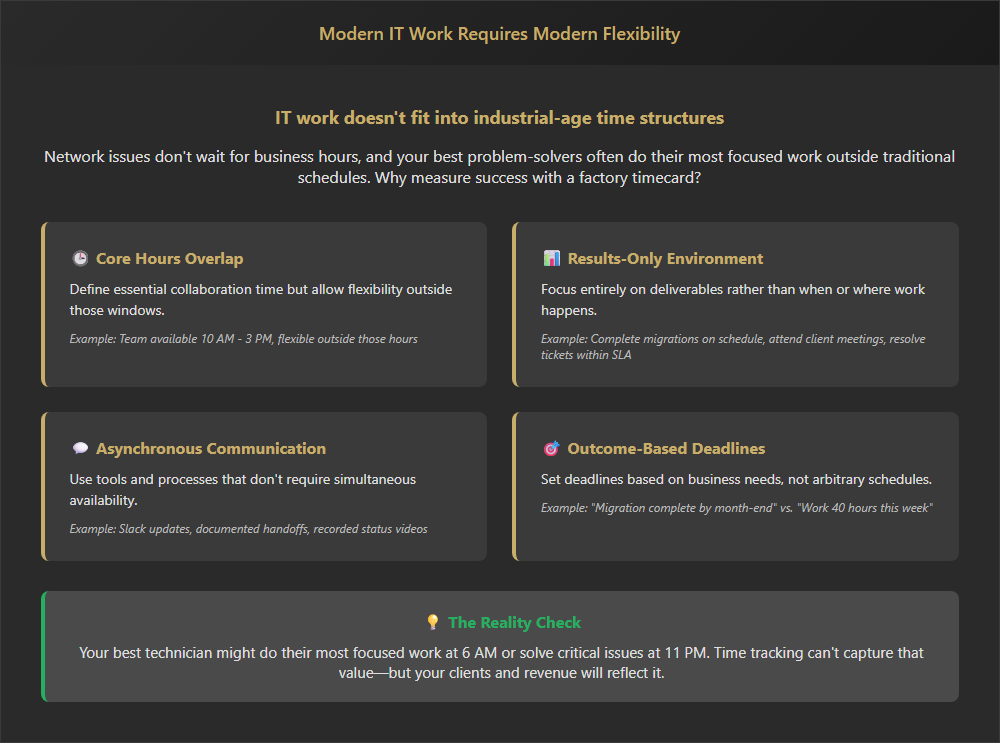
Client Issue Resolution
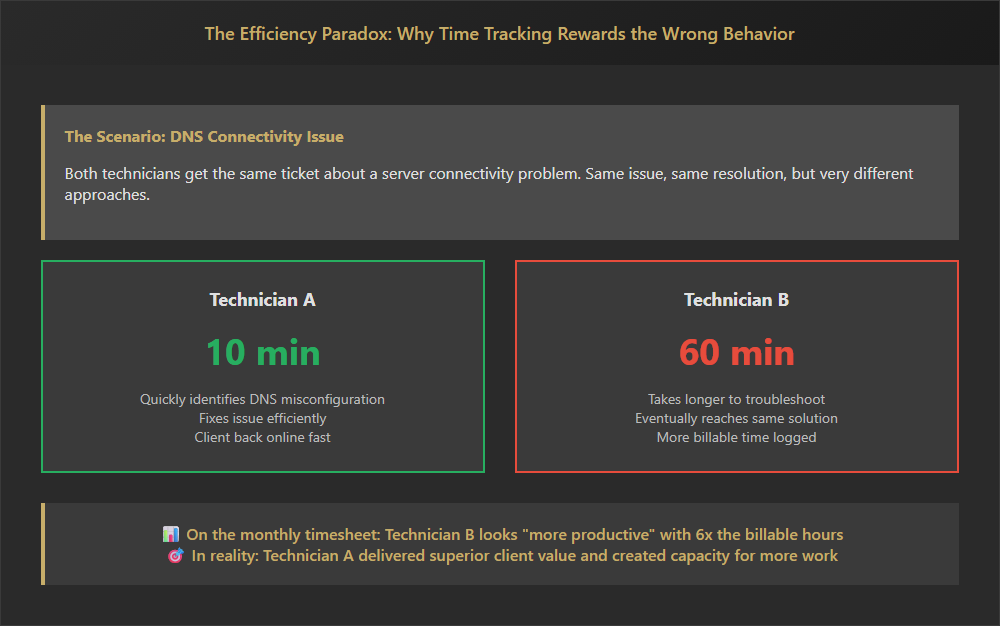
Are problems being solved effectively and efficiently? Here’s where time tracking creates some perverse incentives that most MSP owners don’t think about.
Picture this: Technician A receives a ticket about a server connectivity issue. They quickly identify it’s a DNS configuration problem and fix it in 10 minutes. Technician B gets the same type of ticket and spends an hour troubleshooting, eventually reaching the same resolution.
When you look at the timesheet at the end of the month, Technician B looks “more productive” with an hour of billable time, while Technician A only shows 10 minutes. But who actually delivered more value to your client?
Yet our time-obsessed metrics reward inefficiency over expertise.
Team Development and Knowledge Transfer
Now, what happens when Technician A (our 10-minute problem solver) spends 20 minutes walking Technician B through the DNS troubleshooting process? Traditional time tracking sees this as “unproductive” time—after all, nobody’s directly billing for those 20 minutes.
But here’s what actually happened: you just invested 20 minutes to potentially save hours on future tickets. Next time a similar issue comes up, Technician B might resolve it in 15 minutes instead of an hour. That knowledge transfer just created a 45-minute efficiency gain that will compound over time.
Your senior techs spending “unproductive” time mentoring junior staff isn’t lost time—it’s the highest-leverage investment you can make in your team’s capability and your company’s future. Yet time tracking systems often discourage this behavior because it doesn’t fit neatly into billable categories.
Quality of Service Delivery
Here’s where the efficiency gap really impacts your bottom line. When Technician A consistently resolves issues faster, your clients experience:
- Shorter downtime windows
- Faster response to critical incidents
- More predictable service delivery
- Higher confidence in your team’s capabilities
Meanwhile, the hour that Technician B spent on that DNS issue is an hour your client’s systems were down or performing poorly. Which scenario do you think leads to better client retention and referrals?
Innovation and Process Improvement
But the story doesn’t end with knowledge transfer. Let’s say Technician A takes another 30 minutes to properly document the DNS troubleshooting process—not just “fixed DNS issue” but a detailed runbook with screenshots, common variations of the problem, and preventive measures.
From a time tracking perspective, this looks like “overhead.” But what actually happened? You now have:
- A reusable troubleshooting guide that speeds up future incidents
- Documentation that helps with client handoffs
- A foundation for automation opportunities
- Process improvements that can be rolled out across the team
The Trust-Performance Connection
Research consistently demonstrates a positive relationship between employee trust and workplace performance across three key areas: financial performance, labor productivity, and product or service quality.
When employees feel trusted, they’re more likely to:
- Take initiative on complex problems
- Share ideas for operational improvements
- Go the extra mile during critical incidents
- Stay with the company long-term
Conversely, excessive time tracking signals distrust. It tells your team that you don’t believe they can manage their responsibilities without constant oversight.
Better Alternatives to Clock-Watching
So what should MSPs focus on instead of time tracking? Here are some research-backed alternatives that actually drive business results:
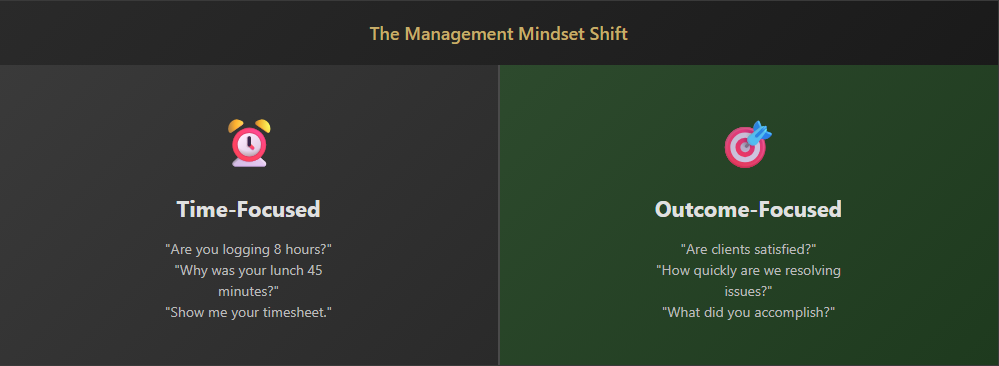
Set Clear Expectations and Outcomes
Instead of micromanaging hours, clearly define what success looks like for each role and project. This means moving from “log 8 hours” to specific, measurable objectives:
- For technicians: “Resolve all P1 tickets within SLA” or “Complete client migrations with zero unplanned downtime”
- For project managers: “Deliver projects on time and within budget while maintaining client satisfaction scores above 8/10”
- For senior staff: “Mentor junior team members and contribute to knowledge base with at least 2 documented processes per month”
Measure What Actually Drives Business Value
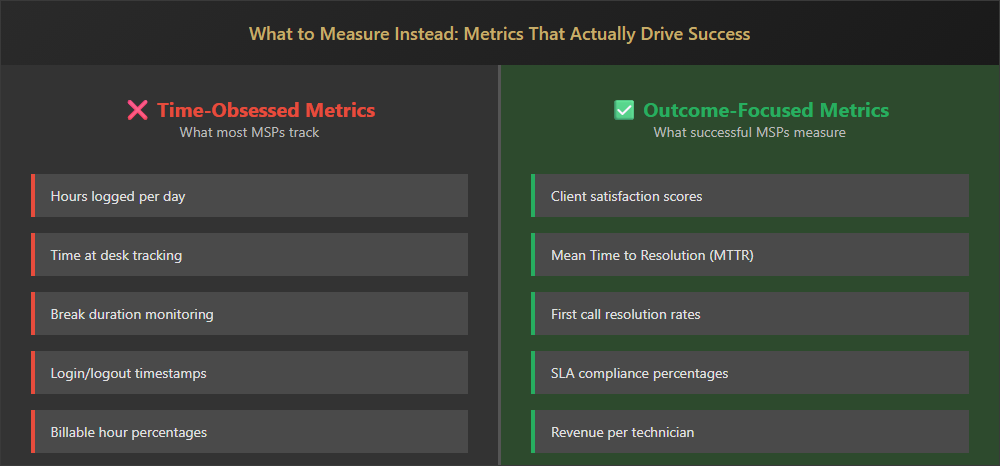
Track metrics that directly impact your bottom line and client relationships:
- Client-Focused: Incident response times, SLA compliance, satisfaction scores, retention rates
- Operational Efficiency: First-call resolution rates, mean time to resolution, documentation quality
- Team Performance: Employee retention, skill development, knowledge sharing, innovation contributions
- Financial Health: Revenue per technician, profit margins per client, cost per ticket
Notice how none of these require minute-by-minute time tracking, yet they give you a complete picture of business health.
Create Psychological Safety and Autonomy
The most productive teams feel safe to take risks, ask questions, and admit when they don’t know something. This environment is impossible to create when people feel constantly monitored and judged.
Practical ways to build psychological safety:
- Respond to mistakes with curiosity, not punishment
- Celebrate learning and improvement over perfection
- Encourage experimentation and calculated risks
- Make it safe to say “I don’t know” or “I need help”
- Recognize and reward problem-solving, not just problem-fixing
The Bottom Line
The most successful MSPs I’ve encountered have learned this lesson: trust your people, measure what matters, and focus on outcomes. Their teams are more engaged, more productive, and frankly, more profitable.
Your team chose to work in IT because they’re problem-solvers, not because they wanted to become time-clock prisoners. When you shift from managing time to managing outcomes, you unlock their potential and create an environment where both people and profits can thrive.
The 8-hour workday was designed for factory workers in the industrial age. Your MSP is a knowledge business in the digital age. It’s time your management approach reflected that reality.
About the Author: Zoe Montague is the Founder & Principal IT Consultant at Silverfern Technology Consultants, specializing in helping MSPs and MSSPs optimize their operations and build stronger teams. With extensive experience in cloud engineering and technical consulting, Zoe brings an insider’s perspective to the unique challenges facing managed service providers across the US and Canada.
Research Sources
- Aeon, B., Faber, A., & Panaccio, A. (2021). Does time management work? A meta-analysis. PLOS ONE
- Brown, G., Holtham, C., & Rich, N. (2014). Employee trust and workplace performance
- Harvard Business School Online. (2020). How to Stop Micromanaging Your Employees
- White, R. D. (2010). The micromanagement disease: Symptoms, diagnosis, and cure
- Gallup. (2020). State of the global workplace report