
The MSP Vendor Risk Cascade: When One Vendor's Failure Becomes 50 Client Emergencies
By Zoe Montague · · 10 min read
- Vendor Management
- Due Diligence
- MSP Consulting
- Risk Management
- Cloud Infrastructure
I was in a vendor meeting early this week when the sales rep said something that instantly triggered my cascade alarms: “We’re 100% cloud-based.” The tone was reassuring, confident, meant to convey reliability. My client nodded along, focused on features.
All I could think was: what happens when their cloud provider has a bad day?
Look, I love cloud technology. I’ve spent years migrating MSP clients to the cloud, building cloud architectures, and advocating for cloud adoption. Cloud infrastructure offers incredible scalability, flexibility, and capabilities that on-premises systems simply can’t match. But as an MSP, you need to understand that “100% cloud-based” isn’t just a feature. It’s a dependency chain that amplifies across every client you manage.
This Zero Trust solution we were evaluating would become the authentication gateway for every remote worker across every client environment my client manages. One vendor dependency, multiplied by 50+ clients, multiplied by 30+ users per client.
That’s when the cascade pattern crystallized for me. I’ve been seeing this risk multiplier effect for years, but I’d never named it. Now I call it the MSP Vendor Risk Cascade: when one vendor’s failure doesn’t just impact your business, it cascades through your tech stack, across every client environment you manage, and potentially brings down dozens or hundreds of businesses that depend on you.
Once you see the cascade, you can’t unsee it. And you start seeing it everywhere.
Anatomy of the MSP Vendor Risk Cascade
Let me show you exactly how this cascade works. Not theoretical risk management frameworks. The actual sequence of events that unfolds when a critical vendor has a problem.
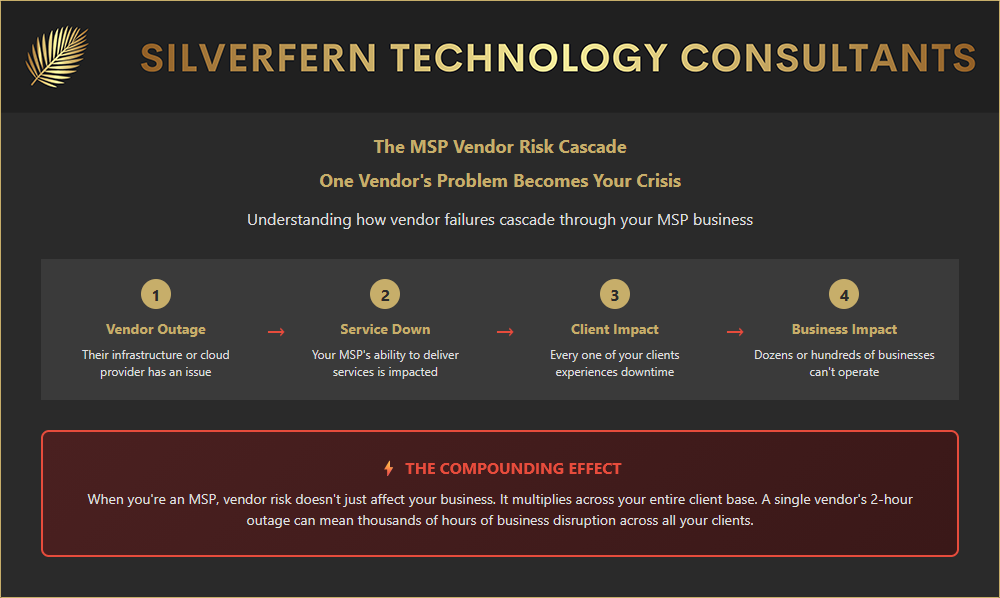
Here’s the cascade that was forming in my head during that meeting:
Stage 1: Cloud Provider Issue
The Zero Trust vendor runs on a major cloud provider. That provider has a regional availability zone issue. Not catastrophic. Not even unusual. These happen to AWS, Azure, GCP, all of them eventually. But it’s happening right now, and that region hosts the authentication gateways for your clients.
Stage 2: Vendor Service Degradation
The vendor’s gateways in that region stop responding. Auto-failover works (if you’ve configured multiple gateways, which most implementations don’t because it costs more). But there’s still a 5-10 minute window where authentication is failing or severely degraded.
Stage 3: Authentication Failure Across All Client Environments
Every remote employee at every one of your MSP clients using this Zero Trust solution can’t authenticate. They can’t access company resources, applications, files. They can’t work. And it’s happening to all of them simultaneously.
Stage 4: Client Business Impact Multiplies
Your MSP has 50 clients. Average of 30 remote workers per client. That’s 1,500 people who suddenly can’t do their jobs. Sales teams can’t access CRM. Support teams can’t reach ticketing systems. Executives can’t get to email. Finance can’t process payroll.
Stage 5: Cascade Becomes Crisis
Your phone starts ringing. Then it doesn’t stop. All 50 clients are calling, many with multiple people from their organizations, all asking why their systems are down. Your helpdesk is overwhelmed. Your techs are fielding calls about a problem they can’t fix. Because you don’t control the infrastructure. You’re completely dependent on the cloud provider fixing their availability zone and the vendor getting their gateways back online.
That’s the MSP Vendor Risk Cascade. One cloud provider hiccup becomes 50 simultaneous client emergencies becomes thousands of hours of lost productivity becomes damage to your reputation that you didn’t cause but absolutely have to own.
This isn’t an argument against cloud technology. It’s about understanding your vendor risk profile.
Why MSPs Face Amplified Risk
If you’re an internal IT team, vendor risk is contained. One outage affects your organization. You’re managing a single failure scenario. Your communication is internal. Your blast radius is limited to your own users.
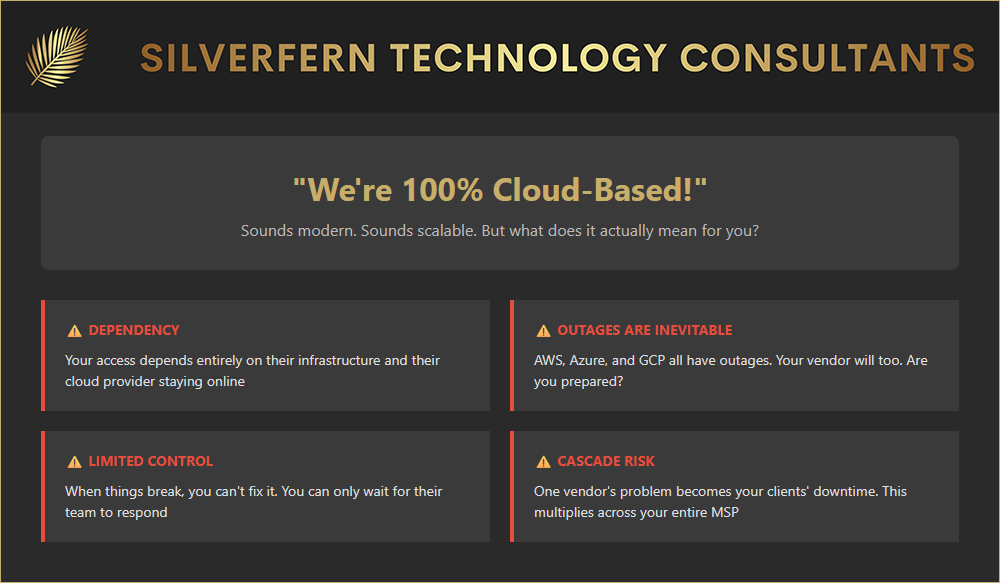
But as an MSP? That same vendor outage hits every environment you manage. Your risk multiplies by your client count. A two-hour outage isn’t just two hours of downtime. It’s:
Cascade Math:
- 2 hours × 50 clients = 100 client-hours of impact
- 100 client-hours × 30 users average = 3,000 user-hours of downtime
- 3,000 user-hours × $75 average hourly productivity = $225,000 in lost business value
- Plus: Reputation damage that can’t be easily quantified
And here’s what keeps me up at night: you can’t fix it. When your own infrastructure fails, you troubleshoot it. You rebuild it. You fail over to backup systems. You have control.
When a vendor’s cloud infrastructure fails? You open a support ticket and wait. You monitor their status page. You try to get updates from your account rep who’s probably getting hammered by every other MSP experiencing the same issue.
Your ability to serve your clients is now completely dependent on someone else’s incident response team.
This is why vendor due diligence isn’t just important for MSPs. It’s existential. Your vendors aren’t just service providers. They’re critical dependencies woven into your tech stack, and their failure points become your failure points, amplified across every environment you manage.
(And yes, on-premises infrastructure has its own cascade risks. Power failures, hardware problems, network outages. The point isn’t cloud vs. on-prem. The point is understanding and mapping your dependencies no matter where they live.)
Mapping the Cascade in That Vendor Meeting
So while my client was evaluating features and capabilities, I was mapping the cascade. Not to be paranoid. Not to torpedo the deal. But to understand exactly what we were signing up for and whether this vendor had thought through their own cascade risks.
The Cascade Mapping Questions:
- Which cloud provider are you on? (Understanding the foundation)
- Were you impacted by recent major cloud provider outages? (Testing their resilience)
- What BCDR processes do you have for cloud provider outages? (Their plan for cascade prevention)
- What failover control do we have? (Our ability to limit cascade impact)
- If the gateway goes down, what happens? (Understanding the exact failure mode)
- Do you have documented uptime and support SLAs? (What guarantees exist when cascade occurs)
Every question was designed to map a specific stage of the potential cascade. Where are the dependencies? What are the failure modes? How much control do we have? What guarantees exist?
The vendor handled most of these well. They weren’t impacted by recent major cloud outages. Their SOC monitors 24/7, they target 99.99% uptime, auto-failover works between gateways if you configure redundancy. These were good answers that showed they understood their own infrastructure risks.
But then I asked about their documented uptime SLA. The sales rep wasn’t sure. They could confirm a 5-minute support response SLA but couldn’t verify if the uptime guarantee was in writing. To their credit, they offered to connect us with technical resources who could answer that.
This is the gap you need to know about before you’re explaining a cascade to 50 clients. Not because it makes the vendor bad (it doesn’t), but because when you’re in Stage 5 of the cascade, “I think they have an uptime SLA” doesn’t help you communicate with clients.
You need to know exactly what happens when the cascade hits. Before it hits.
Every Vendor Is a Potential Cascade
After that meeting, I started looking at all the vendors in my clients’ stacks differently. RMM platform. PSA. Backup solution. Email security gateway. SIEM. Documentation platform. Every single one is a potential cascade trigger.
Pick your most critical vendor right now. Not your favorite. Not the one with the best support. The one whose failure would hurt the most across the most clients.
Now map your cascade:
Stage 1: What triggers their failure?
Cloud provider outage? Network connectivity? Cyberattack? Database corruption? What’s their weakest link? What has actually failed in the past? (Check their status page history.)
Stage 2: What stops working immediately?
Is it just monitoring alerts? Or is it authentication, backup jobs, ticketing, documentation access? What functionality depends entirely on this vendor being available?
Stage 3: How many clients are hit?
Is this vendor deployed across all clients? Half your clients? Just your enterprise tier? What’s the actual blast radius? How many phone calls are you about to receive?
Stage 4: What control do you have?
Can you switch to a backup system? Fail over to a different region or provider? Implement a workaround? Or are you completely dependent on their team bringing services back online?
Stage 5: How do you communicate during the cascade?
When 30 clients call simultaneously, what do you tell them? How do you keep them updated when you don’t control the timeline? What’s your status page say? What does your team say on support calls?
If you can’t confidently answer all five stages for your top five vendors, you don’t understand your cascade risks. You’re hoping nothing breaks instead of preparing for when it does.
Hope is not a business continuity strategy.
What Good Vendor Cascade Awareness Looks Like
Back to that vendor meeting. Here’s what impressed me about how they handled my cascade mapping questions:
They understood why I was asking
When I started mapping infrastructure dependencies and failure scenarios, they didn’t get defensive. They recognized these as legitimate operational questions from someone who understands MSP risk amplification.
They admitted what they didn’t know
The sales rep didn’t fabricate answers or deflect when unsure about documented SLAs. They acknowledged the gap and offered to connect us with technical resources who could answer definitively. That’s integrity under pressure.
They had real implementation details
They could explain auto-failover architecture, SOC monitoring procedures, gateway redundancy configuration. Not marketing promises. Actual technical implementation that showed they’d thought through their own cascade risks.
They acknowledged that outages happen
They didn’t claim 100% uptime or “we’ve never had an issue.” They talked about incident response processes and how they communicate during problems. They understand that cascade prevention is about preparation, not perfection.
That’s a vendor who understands they’re being evaluated as a potential cascade trigger in an MSP environment. They’re not perfect (no one is), but they’re transparent about capabilities and limitations.
Compare that to vendors who get defensive about infrastructure questions, claim everything is proprietary, or can’t produce documentation for their SLAs. Those responses tell you exactly how they’ll handle an actual cascade event. Believe them the first time.
My Client’s Cascade Awareness Journey
We’re moving forward with a December trial. Not because I scared my client away from the vendor, but because we’re now making an informed decision about the cascade risk we’re accepting.
My client understands the five stages. They know which questions still need answers. They’ll go into that trial specifically testing cascade scenarios: what happens when we simulate gateway failure? How do their users experience authentication problems? How quickly does failover actually work? Can they communicate the right information during a cascade?
And here’s what’s changed: they’re now looking at every vendor in their stack through the cascade lens. RMM platform? Map the cascade. PSA? Map the cascade. Backup solution? Map the cascade. Email security? Map the cascade.
Once you see the MSP Vendor Risk Cascade, you start seeing it in every vendor relationship.
That’s not paranoia. That’s operational maturity. Understanding that vendors aren’t just service providers. They’re critical dependencies woven into your infrastructure and your clients’ operations. Their failure becomes your failure, amplified across every environment you manage.
Start Mapping Your Vendor Cascades Today
Don’t wait for an outage to understand your cascade risks. Start mapping them now:
-
List your top 10 vendors by criticality (what hurts most when it breaks)
-
For each vendor, map all five cascade stages
-
Count actual client impact numbers (not estimates)
-
Document what control you actually have (not what you wish you had)
-
Review their documented SLAs (the contract, not the marketing)
-
Build your cascade communication plan (before you need it)
Every vendor will eventually have a failure. Cloud providers have outages. Networks have problems. Software has bugs. Hardware breaks. The question isn’t if. It’s when, how bad, and whether you’re prepared.
Understanding your vendor cascades means you’re not surprised when something breaks. You’ve already mapped the blast radius. You know which clients are impacted. You have a communication plan ready. You’re not scrambling. You’re executing a plan you built when you had time to think clearly.
That’s the difference between managing an incident and surviving a crisis.
About the Author: Zoe Montague is the Founder & Principal IT Consultant at Silverfern Technology Consultants, specializing in helping MSPs and MSSPs understand and manage operational risk. With extensive experience in cloud engineering and MSP operations, I help firms build resilient technology stacks and make informed vendor decisions. Connect with me on LinkedIn.
Need Help Mapping Your Vendor Risk Cascades?
If you’re an MSP looking to understand your vendor dependencies, evaluate critical infrastructure decisions, or build more resilient operations, Silverfern Technology Consultants can help. I work with MSPs to map their vendor cascades, assess risk amplification, and build practical mitigation strategies.