
Mapping Your MSP's Growth Journey: Understanding the Operational Maturity Framework
By Zoe Montague · · 18 min read
- MSP Growth
- Operations
- Strategic Planning
- Business Development
As an IT consultant who works closely with Managed Service Providers (MSPs) and Managed Security Service Providers (MSSPs), I frequently encounter businesses struggling with the same fundamental question: “How do we know if we’re truly growing, or just getting busier?”
The answer often lies in understanding where your organization sits on the operational maturity spectrum. Today, I want to share insights from The MSP KB’s Operational Maturity Framework (OML)—a powerful tool that can help you assess your current position and chart a path forward.
What is the Operational Maturity Framework?
The Service Leadership Operational Maturity Framework was specifically designed to help MSPs evaluate and improve their operational efficiency, profitability, and client satisfaction. Rather than offering generic business advice, this framework addresses the unique challenges faced by MSPs at different stages of growth and development.
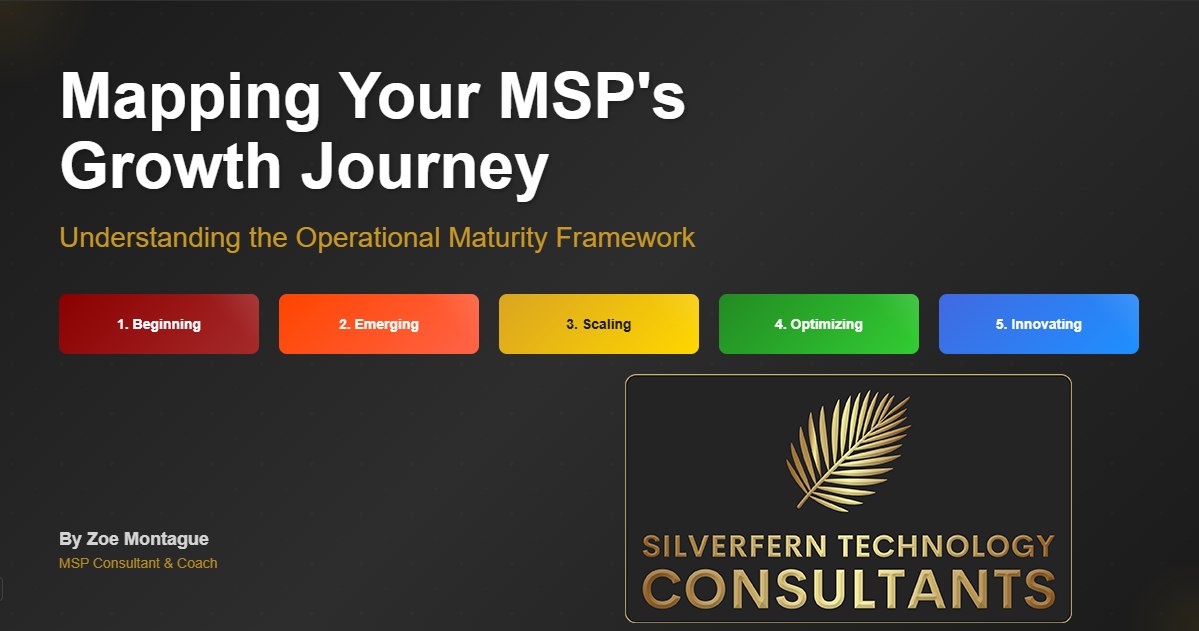
The framework consists of five distinct levels, each with specific characteristics and improvement strategies. Let’s explore what each level looks like and how you can use this knowledge to advance your business.
Key Characteristics Comparison
| Aspect | Level 1: Beginning | Level 2: Emerging | Level 3: Scaling | Level 4: Optimizing | Level 5: Innovating |
|---|---|---|---|---|---|
| Financial Performance | Low/Negative margins | Sporadic profitability | Consistent median performance | Above-average performance | Exceptional performance |
| Process Maturity | Ad-hoc, reactive | Basic processes implemented | Established, documented | Optimized, continuously improved | Innovative, industry-leading |
| Team Structure | Founder-dependent | Growing, basic roles | Structured departments | Specialized teams | Leadership at all levels |
| Technology Focus | Basic tools | Standard MSP stack | Integrated platforms | Advanced automation | Cutting-edge innovation |
| Client Relationships | Personal connections | Formal agreements | Strategic partnerships | Trusted advisor status | Market influencer |
The Five Levels of Operational Maturity
Level 1: Beginning
Characteristics: Low to negative financial performance, inconsistent service delivery
Level 1 MSPs are typically experiencing the growing pains of early-stage businesses. You might find yourself constantly firefighting, struggling with cash flow, and wondering why profitability seems so elusive despite working harder than ever.
Common challenges at this level include:
- Inconsistent or non-existent time tracking leading to undercharging clients
- Reactive service delivery with no standardized processes
- High employee turnover due to lack of structured onboarding
- Pricing based on “gut feeling” rather than data-driven analysis
Typical Metrics at Level 1
| Metric | Typical Range | Target Goal |
|---|---|---|
| Gross Margin | -10% to +15% | 25%+ |
| Employee Turnover | 40-60% | <20% |
| Time Utilization | 40-60% | 75%+ |
| SLA Compliance | 60-70% | 95%+ |
Level 2: Emerging
Characteristics: Improving financial performance, developing process awareness
Level 2 MSPs have begun implementing basic tracking and processes from Level 1, but are still working toward consistent profitability. You’re likely seeing some months that are profitable and others that aren’t, and you’re beginning to understand why.
Key improvement areas:
- Operational Controls: Implement change management processes, documentation standards, and basic quality assurance
- Pricing Refinement: Analyze time tracking data to adjust pricing based on actual data
- Financial Planning: Develop 12-month budgets and begin monthly financial reviews
- Team Alignment: Introduce basic performance metrics and tie compensation to operational goals
Target Metrics at Level 2
| Gross Margin | 35% |
|---|---|
| Employee Turnover | 25% |
| Time Utilization | 70% |
| SLA Compliance | 85% |
Level 3: Scaling
Characteristics: Consistent median performance, established processes
Level 3 MSPs have achieved operational stability and consistent, if not exceptional, performance. You’re no longer wondering if you’ll make payroll, but you’re also not seeing the growth rates or margins you know are possible.
Key improvement areas:
- Process Optimization: Review and refine existing processes based on data and experience
- Advanced Financial Management: Move to forecasting, scenario planning, and detailed profitability analysis
- Service Delivery Excellence: Standardize service offerings and implement proactive monitoring
- Strategic Compensation: Develop sophisticated incentive programs tied to both individual and company goals
Target Metrics at Level 3
| Gross Margin | 65% |
|---|---|
| Employee Turnover | 12% |
| Time Utilization | 78% |
| SLA Compliance | 92% |
| Client Satisfaction | 4.1/5 |
Level 4: Optimizing
Characteristics: High performance with focus on continuous improvement
Level 4 MSPs are high performers who have moved beyond just “getting things done” to strategic optimization. You’re likely outperforming many of your competitors and have established your MSP as a preferred partner in your market.
Key improvement areas:
- Continuous Improvement Culture: Implement formal process improvement methodologies like Six Sigma or Lean
- Advanced Analytics: Utilize business intelligence tools and predictive analytics for strategic decisions
- Technology Leadership: Stay ahead of trends and implement cutting-edge solutions before competitors
- Strategic Partnerships: Develop deeper relationships with key vendors and negotiate better terms
Level 5: Innovating
Characteristics: Industry leadership and market innovation
Level 5 MSPs are the industry leaders that others benchmark against. You’re not just succeeding in your market—you’re defining what success looks like for the entire industry.
Key focus areas:
- Market Innovation: Continuously develop new service offerings that address emerging market needs
- Strategic Partnerships & Ecosystem Development: Build partnerships that create competitive moats
- Organizational Culture & Leadership: Create a culture that attracts and retains top talent
- Data-Driven Strategic Decision Making: Utilize advanced analytics and AI for strategic decisions
- Thought Leadership: Establish your organization as thought leaders in the industry
Using the OML Framework for Strategic Planning
The power of this framework lies not just in assessment, but in providing a clear roadmap for improvement. Instead of trying to fix everything at once—a common mistake I see MSPs make—you can focus your efforts on the specific areas that will have the greatest impact at your current maturity level.
When I work with MSP clients, I often start by honestly assessing their current OML level. This isn’t about judgment; it’s about creating a baseline for improvement. From there, we can develop targeted strategies that address the specific challenges and opportunities at their level.
Moving Forward: Your Next Steps
Take a moment to honestly assess where your MSP currently stands. Which level’s characteristics most closely match your current situation? More importantly, what specific areas within that level need your immediate attention?
Remember, progression through these levels isn’t automatic—it requires intentional effort, strategic planning, and often, external guidance to see the blind spots that every business owner has.
A Note of Gratitude
I want to acknowledge The MSP KB, an open-source resource created by Ashley Cooper and Kelvin Tegelaar, for providing this valuable framework to our community. Resources like these demonstrate the collaborative spirit that makes our industry stronger.
At Silverfern Technology Consultants, I help MSPs and MSSPs navigate these operational transformations through targeted consulting and coaching. Sometimes an outside perspective is exactly what you need to identify the specific changes that will move you to the next level.